
Selecting the right paving material for your property is one of the most significant financial and functional decisions you will make during a construction or renovation project. The surfaces that surround a property—whether they form a sweeping driveway, an expansive parking area, or a welcoming courtyard—do much more than just provide a place to park vehicles or walk. They fundamentally anchor the aesthetic identity of the property, establish the vital first impressions that define curb appeal, and play a crucial role in directing water drainage away from sensitive building foundations. Beyond aesthetics, your paving choice represents a major capital investment. Making the wrong decision can lead to years of frustrating maintenance, premature structural failure, and a poor return on investment.
When you embark on a hardscaping project, you are generally choosing between the three primary contenders in the paving industry: asphalt, poured concrete, and interlocking pavers. Each of these materials possesses distinct physical properties, requires entirely different installation methodologies, and offers unique aesthetic possibilities. They also come with vastly different initial price tags and long-term maintenance requirements.
Asphalt is widely celebrated for its cost-effectiveness, its rich, dark finish, and its ability to flex under the pressure of shifting soils. Poured concrete is renowned for its incredible rigid strength, its crisp, clean appearance, and its unmatched longevity under heavy static loads. Interlocking pavers offer the pinnacle of high-end design flexibility, providing an upscale look that can mimic natural stone or historic brick while offering unique structural advantages through their modular nature.
This comprehensive guide is designed to take you on a deep dive into the world of hardscape materials. Over the course of this breakdown, we will explore the underlying material science of each option, detail the critical installation steps that make or break a project, and provide you with actionable strategies for long-term maintenance. By understanding how these materials perform under different climates, budgets, and load requirements, you will be fully equipped to make an informed, confident decision that maximizes the value and performance of your property for decades to come.
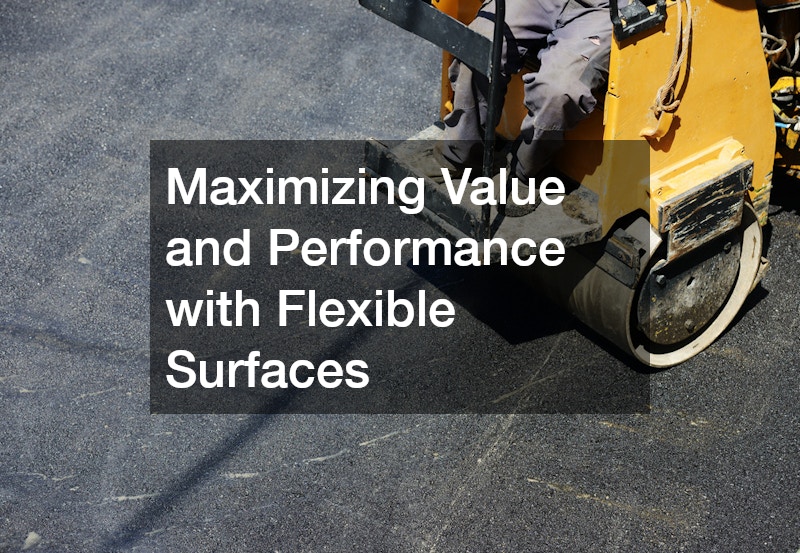
Maximizing Value and Performance with Flexible Surfaces
Structure a Multi-Layer Base to Withstand Heavy Vehicle Loads
To understand how to get the most out of a blacktop surface, you first have to understand the material’s structural philosophy. Asphalt is known in engineering terms as a “flexible pavement.” Unlike rigid slabs, it is formulated from a mixture of stone aggregates bounded together by a highly viscous petroleum byproduct called bitumen. This flexibility is its greatest asset, allowing it to subtly bend and flex with the natural freeze-thaw cycles of the earth without instantly snapping. However, this flexibility also means that the surface is entirely reliant on the strength of the foundation beneath it. If the sub-base is weak, the surface will undoubtedly fail.
Building a resilient surface requires extensive groundwork. The first step involves excavating the native soil to a sufficient depth, removing organic materials like topsoil, clay, and root systems that hold moisture and cause frost heave. Once the native subgrade is exposed, it must be aggressively compacted. Depending on your local soil conditions, a geotextile fabric may be laid down to separate the native soil from the aggregate base, preventing mud from pumping up into the clean stone over time.
The structural integrity of the project heavily relies on the crushed stone sub-base. This base layer typically consists of angular crushed stone that locks together when compacted. For light vehicular traffic, a compacted base of six to eight inches might be sufficient, while heavy-duty zones may require twelve inches or more. It is highly recommended that you rely on experienced asphalt driveway contractors to handle this phase. Professionals have access to heavy vibratory rollers and understand how to evaluate soil plasticity, ensuring that the base is graded with a minimum slope of a quarter-inch per foot to facilitate rapid water runoff. Only after this robust foundation is established should the hot-mix binder and surface courses be applied, rolled, and compacted to their final densities.
Schedule Routine Surface Treatments to Shield Against the Elements
While a properly installed flexible pavement can last up to two decades, its lifespan is entirely dependent on how well it is protected from its two greatest enemies: ultraviolet radiation and water penetration. Immediately after installation, the bitumen binder is rich, black, and highly elastic. Over time, constant exposure to the sun’s UV rays causes the surface to undergo oxidation. This chemical process strips the oils from the binder, causing it to dry out, lose its elasticity, and fade to a brittle, pale gray. As the binder becomes brittle, microscopic cracks begin to form under the weight of passing vehicles.
Once these surface cracks open up, water becomes the primary catalyst for destruction. Rainwater seeps into the fissures, penetrating the sub-base. In colder climates, this water freezes and expands by approximately nine percent, forcing the cracks wider in a process known as frost wedging. When the ice melts, it leaves a void beneath the surface, which eventually collapses under the weight of a car tire, forming a pothole.
To break this cycle of degradation, proactive maintenance is absolutely essential. Property owners should establish a strict schedule of preventative care to preserve the integrity of the binder.
-
Crack Routing and Sealing: Before winter sets in, all linear cracks wider than a quarter-inch should be cleaned of debris and filled with a hot-poured rubberized crack sealant. This flexible material moves with the surface and blocks water from reaching the base.
-
Surface Protection: Every three to five years, it is crucial to apply a protective barrier over the entire surface. Investing in routine sealcoating services acts as a powerful sunscreen for the pavement, replenishing lost oils, blocking UV rays, and providing a barrier against automotive fluid leaks that can dissolve the bitumen.
-
Oil Stain Remediation: Because bitumen is petroleum-based, gas and oil leaks from vehicles will chemically break down the surface. Regular cleaning of these stains using specialized degreasers prevents localized soft spots.
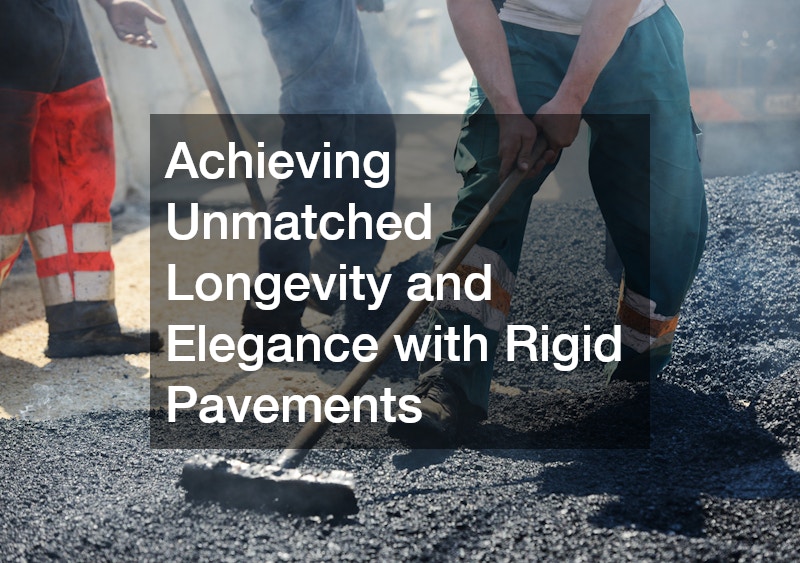
Achieving Unmatched Longevity and Elegance with Rigid Pavements
Pour Thicker Slabs and Reinforce High-Stress Zones
If flexible pavement relies entirely on the sub-base to carry the load, poured concrete operates on the opposite principle. Known as a “rigid pavement,” it possesses immense structural strength and distributes heavy loads over a wide area, much like a snowshoe distributes a person’s weight over soft snow. Composed of a mixture of Portland cement, varying sizes of aggregate, and water, the material undergoes a chemical reaction called hydration, curing into an incredibly dense, rock-like slab.
Because it is a rigid material, it is inherently susceptible to cracking when subjected to extreme tension or when the earth beneath it settles unevenly. To counter this, proper engineering of the slab is paramount. Standard residential surfaces are often poured at a depth of four inches, but for areas expecting the weight of large trucks, delivery vehicles, or recreational vehicles, stepping up to a full six-inch depth with a high-PSI (pounds per square inch) mix is highly recommended.
Reinforcement is the secret to a slab’s longevity. While the mixture is incredibly strong under compression, its tensile strength is relatively weak. Embedding a grid of steel rebar or heavy-duty welded wire mesh into the center of the slab holds the material together even if micro-cracks occur, preventing horizontal separation and vertical displacement. Working with a knowledgeable commercial concrete contractor is vital for ensuring that these reinforcements are placed correctly on “chairs” so they sit perfectly in the middle of the pour, rather than sinking to the bottom where they are useless. Furthermore, these professionals will strategically cut control joints (purposeful weak points) into the curing slab, ensuring that as the slab shrinks and expands, it cracks in a straight, invisible line inside the joint rather than randomly across the surface.
Utilize Texturing and Stamping Techniques to Elevate Aesthetic Value
Historically, rigid poured surfaces were viewed strictly in utilitarian terms—a sea of plain, industrial gray. However, modern chemical admixtures and finishing techniques have revolutionized the aesthetic potential of the material, turning it into a highly sought-after design element for upscale properties.
Property owners are no longer restricted to a simple broom finish. By introducing integral color pigments directly into the mixing truck, the entire slab can be dyed to match the architectural tones of the surrounding buildings. Alternatively, dry-shake color hardeners can be broadcast across the surface before it sets, creating rich, mottled tones.
-
Stamping and Texturing: Specialized decorative concrete contractors can press large polyurethane mats into the partially cured surface to imprint incredibly realistic textures. This technique allows a standard slab to mimic the appearance of weathered wood planks, natural flagstone, cobblestones, or slate, providing a premium look at a highly competitive price point.
-
Exposed Aggregate: By applying a surface retarder and gently washing away the top layer of cement paste, the colorful stones and pebbles within the mix are exposed. This creates a visually striking, highly slip-resistant surface ideal for pool decks and courtyards.
-
Staining and Sealing: Acid stains chemically react with the minerals in the cured slab to create permanent, translucent, variegated colors. Once the desired look is achieved, applying a high-grade, UV-resistant acrylic or silane-siloxane sealer is critical. This locks in the color, prevents the penetration of water and deicing salts, and protects against surface spalling (scaling).
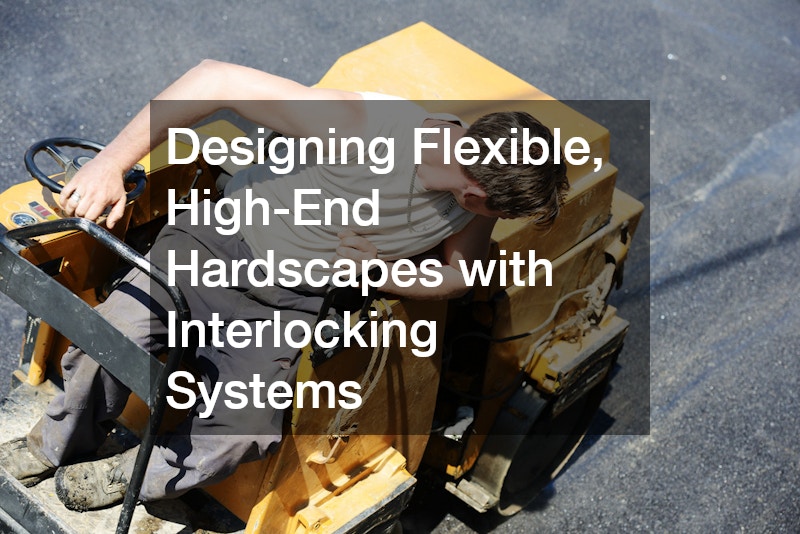
Designing Flexible, High-End Hardscapes with Interlocking Systems
Establish an Impeccable Slope and Sub-Base to Prevent Shifting
Interlocking systems represent a completely different engineering philosophy compared to poured slabs or blacktop. Rather than creating a single monolithic surface, this method relies on hundreds or thousands of individual, high-density manufactured stones set into a bed of sand. The magic of this system lies in the friction created between the tight joints and the surrounding sand, which locks the individual units together into a unified, flexible mat. Because there is no rigid mortar binding the pieces, the surface can shift, heave, and settle with the earth without ever cracking.
However, because the surface is entirely modular, it is hyper-sensitive to the quality of the foundation beneath it. A poorly constructed sub-base will inevitably lead to sagging, rutting, and a wavy, unsightly surface. The process begins with deep excavation and the laying of a woven geotextile fabric to stabilize the soil. Next, layers of crushed angular gravel are introduced, compacted in two-inch lifts to achieve maximum density.
The final leveling layer is the bedding sand, which must be perfectly screeded to an exact depth (typically one inch). If the sand layer is too thick, the units will sink and shift under pressure; if it is too thin, they will not bed properly. When executing a complex paver patio installation, establishing the correct drainage slope during the base preparation is arguably the most critical step. Because water can seep through the joints of the surface, the sub-base itself must be sloped away from any building foundations to prevent hydrostatic pressure from causing basement leaks or structural damage.
Secure the Perimeter with Heavy-Duty Edging to Block Movement
Once the modular stones are laid in their designated pattern—whether that is a classic herringbone, a running bond, or an intricate ashlar layout—they must be locked into place. The forces exerted by turning vehicle tires or heavy foot traffic will naturally try to push the blocks outward, away from the center of the installation.
To prevent this lateral movement, robust edge restraints are absolutely non-negotiable. These restraints act as the frame that holds the entire puzzle together. Depending on the scale of the project, edge restraints can take the form of heavy-duty spiked plastic edging, poured-in-place concrete curbing, or structural troweled mortar edges set beneath the soil line. For projects expecting vehicular traffic, particularly those utilizing thick, heavy-duty commercial pavers, the edging must be exceptionally strong, as the lateral forces generated by a turning truck are immense.
The final step in the locking process involves joint sand. Traditional masonry sand can be swept into the joints, but modern installations heavily favor polymeric sand. This advanced material contains synthetic binders that, when activated by a light mist of water, harden to the consistency of flexible concrete. Polymeric sand serves three crucial functions:
-
It creates a rigid but flexible bond that locks the stones together, increasing the overall load-bearing capacity of the surface.
-
It creates an impermeable seal that prevents water from washing out the bedding sand beneath.
-
It creates a highly alkaline environment that prevents weed seeds from germinating in the joints and deters ants and other insects from tunneling through the base.
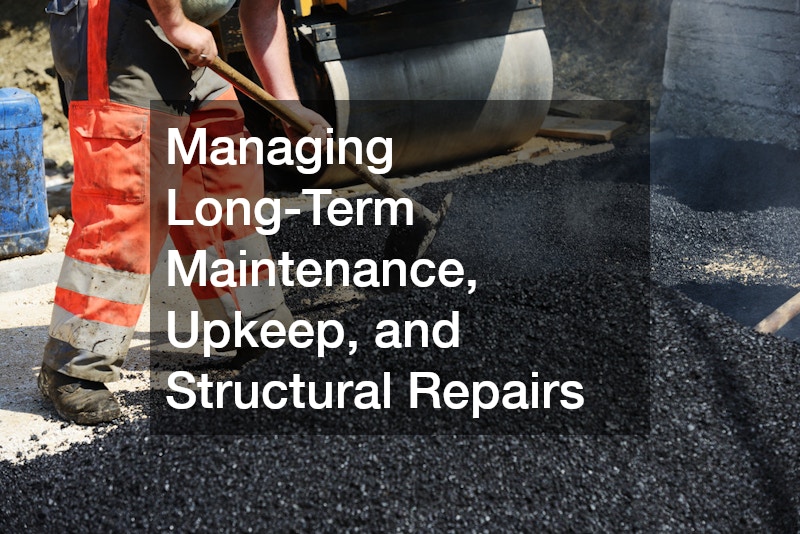
Managing Long-Term Maintenance, Upkeep, and Structural Repairs
Lift and Stabilize Sunken Slabs Early to Prevent Trip Hazards
No matter which material you choose, time, weather, and gravity will eventually take their toll. Understanding how each material fails—and how to fix it—is crucial for calculating the true lifecycle cost of your investment. Flexible pavements tend to suffer from oxidation, alligator cracking, and potholes. Interlocking modular surfaces generally only fail if the base washes out, leading to localized sagging or rutting. Rigid poured slabs, on the other hand, fail by cracking under immense tension or by settling unevenly when the soil beneath them washes away.
When a monolithic slab settles, it creates dangerous, uneven transitions that pose severe trip hazards and potential liability for property owners. In the past, the only solution to a sunken slab was a costly, disruptive process of breaking up the old material with a jackhammer, hauling it away to a landfill, and pouring a brand new slab.
Today, advanced concrete leveling technologies offer a highly effective, cost-efficient alternative. Professionals can drill small, strategically placed holes into the sunken slab and pump in specialized materials to gently raise it back to its original grade. Traditional mudjacking uses a slurry of limestone and water to lift the slab, while modern polyurethane foam injection utilizes lightweight, high-density expanding polymers. The polyurethane expands rapidly, filling voids, stabilizing the loose soil beneath, and lifting the slab with pinpoint precision. This process takes a fraction of the time of a total replacement, costs significantly less, and allows the surface to be used almost immediately.
Stockpile Extra Matching Components for Swift Replacements
One of the greatest advantages of an interlocking modular system is its repairability. If a monolithic poured slab suffers a severe, deep-set oil stain or a heavy impact that causes a massive structural crack, repairing it often leaves an ugly, highly visible patch that never quite matches the original color. If a flexible blacktop surface is cut open to repair an underground utility pipe, the resulting patch is equally obvious and often becomes a weak point where water pools.
Modular interlocking systems bypass this problem entirely. Because the pieces are individual units, a damaged section can simply be unzipped. The affected stones are pried up, the base sand is re-leveled, and new stones are dropped into place. Once the joints are re-sanded and compacted, the repair is completely invisible. The surface is restored to 100% of its original strength without any unsightly scarring.
However, manufactured stones are produced in distinct color batches, and manufacturers frequently discontinue styles or alter their dye formulas. To ensure that future repairs are perfectly seamless, property owners should proactively purchase extra inventory at the time of the initial build. Keeping a few boxes of surplus stones sourced from reliable local paver supplies in a garage or shed guarantees that if a vehicle leaks corrosive fluid or a heavy object chips a stone ten years down the line, an exact color and texture match is immediately available.
Here is a quick breakdown of the annual maintenance expectations for each surface type:
-
Flexible Pavements: Requires bi-annual crack filling; full surface sealing every 3-5 years; vulnerable to oil and gas spills; moderate ongoing maintenance costs.
-
Rigid Pavements: Requires joint sealing to prevent water intrusion; periodic application of penetrating sealers to prevent freeze-thaw scaling; low to moderate ongoing maintenance costs.
-
Interlocking Systems: Requires occasional topping off of polymeric joint sand; periodic washing and sealing to maintain color vibrance; low ongoing maintenance costs, though weeding may be required if polymeric sand is not used.
Navigating Large-Scale Project Layouts and Regulatory Compliance

Design Clear Traffic Flow Segregation to Enhance On-Site Safety
When transitioning from residential driveway projects to larger-scale applications like retail parking lots, sprawling commercial complexes, or multi-family housing developments, the choice of material is only half the battle. The physical layout, directional flow, and regulatory compliance of the surface become paramount. A poorly designed large-scale surface leads to vehicular congestion, pedestrian accidents, and massive liability for the property owner.
Effective site design requires a deep understanding of traffic engineering. Turning radii must be calculated to accommodate the largest vehicles expected on the property, from delivery box trucks to emergency fire apparatus. Traffic flow should be segregated, clearly separating pedestrian walkways from vehicular travel lanes. For commercial properties, strict adherence to the Americans with Disabilities Act (ADA) is a legal requirement. This dictates the exact number of accessible parking spaces required based on total lot capacity, the precise slope and width of access aisles, and the placement of curb ramps.
To navigate these complex regulations, property managers must rely on specialized contractors. Working alongside an experienced pavement marking company guarantees that all painted lines, stencils, and safety crosswalks adhere precisely to local municipal codes and federal accessibility laws, shielding the property owner from fines and legal disputes while drastically improving the safety and efficiency of the environment.
Apply High-Visibility Coatings for Directional Guidance
The final touch on any large-scale surface is the application of directional cues. The paint used on these surfaces must withstand brutal conditions, including the abrasive friction of turning tires, harsh ultraviolet radiation, chemical spills, and the scraping of winter snowplows. Standard house paint will flake away within days.
Contractors must choose the appropriate coating technology based on the specific use case. Waterborne acrylic paints are the industry standard for general parking lot lines, offering a fast drying time and low environmental impact. However, for high-traffic intersections or severe weather climates, highly durable two-part epoxy paints or heat-applied thermoplastic markings are required. Thermoplastic markings, which incorporate reflective glass beads, offer incredible nighttime visibility and can outlast standard paint by several years.
Applying these coatings requires precision equipment. Utilizing professional road striping services ensures that the lines are perfectly straight, evenly spaced, and applied at the correct wet-film thickness. Proper striping maximizes the parking capacity of a lot by tightening space dimensions within legal limits, clearly designates fire lanes and loading zones, and intuitively guides drivers through complex entrance and exit patterns, creating a seamless, safe experience for every visitor to the property.
Comparative Breakdown: Cost vs. Lifespan Matrix
Making the final decision often comes down to balancing the initial budget against long-term lifecycle costs and environmental suitability. Below is a comprehensive comparative breakdown to help crystallize the differences between the three primary options.
-
Initial Installation Costs:
-
Asphalt: The most budget-friendly option upfront. The cost of materials is relatively low, and the installation process is highly mechanized and rapid, resulting in lower labor costs.
-
Concrete: Sits squarely in the middle regarding initial investment. The material costs more than petroleum-based binders, and the labor required for forming, pouring, and finishing is more intensive.
-
Interlocking Pavers: The most expensive initial investment. The cost is driven by the premium price of the manufactured stones and the highly intensive, meticulous manual labor required to prepare the base and lay each individual unit by hand.
-
-
Lifespan Expectations (With Optimal Maintenance):
-
Asphalt: Typically 15 to 20 years. As a petroleum product, it naturally degrades and dries out over time, eventually requiring a full milling and resurfacing.
-
Concrete: Typically 30 to 40 years. With proper reinforcement and sealing, a poured slab can easily last a generation before structural settling or surface spalling necessitates replacement.
-
Interlocking Pavers: 50+ years. The high-density stones themselves can last a lifetime. While the sub-base may eventually need to be re-leveled, the stones can be picked up, the base repaired, and the original stones re-laid, making it a nearly permanent solution.
-
-
Climate Suitability Guide:
-
Extreme Heat Climates: Poured slabs and interlocking stones are vastly superior in desert climates. Petroleum-based surfaces absorb heat and can actually soften in temperatures exceeding 100 degrees Fahrenheit, leading to tire rutting and the tracking of oily residue into buildings.
-
Freeze-Thaw Climates: Flexible pavements and interlocking systems excel in northern climates. Their ability to flex allows them to ride the frost heaves without snapping. Rigid poured slabs are highly prone to surface scaling from de-icing salts and deep structural cracking from winter ground movement.
-
Conclusion
Navigating the complexities of hardscape construction reveals a simple truth: there is no single, universally perfect paving material. Instead, there is only the perfect material for your specific set of circumstances. Your choice must be a calculated balance of your initial budget, your willingness to perform ongoing maintenance, the aesthetic goals of your property, and the realities of your local climate.
If you need a cost-effective, rapid installation that can handle harsh winter shifts, flexible blacktop surfaces offer incredible value. If you desire unyielding structural strength, low ongoing maintenance, and the ability to customize colors and textures, a poured rigid slab is a brilliant long-term investment. If budget is less of a concern and your priority is maximizing curb appeal with a highly durable, repairable, and architecturally stunning surface, modular interlocking systems stand in a class of their own.
As you move forward with your project, take the time to finalize your specific use-case goals. Check your local municipal zoning codes regarding permeability and drainage requirements, and most importantly, solicit comprehensive bids from specialized, reputable professionals in your area. By marrying high-quality materials with expert installation, your newly paved surface will provide safety, functionality, and outstanding curb appeal for decades to come.
About the Author